In the year 2025 alone, the most powerful capability of Salesforce API Integration has shifted from a major demand to an administrative and organizational direction, thus empowering almost all enterprises, for coordination of deeply connected systems for multiple reasons like cloud-native processes, distributed workflow processes, and AI-powered automation processes.
As multiple organizational systems get stuck with multiple problems, as in fragmented data issues, along with escalating demands for major and fast-paced and real-time nimbleness, the strong yet robust API framework of Salesforce acts as a foundation, unifying the handling of majorly contrasting systems, unlatching the actionable insights, and providing automation of all complex systems with and through the power of data governance.
This guide will investigate plus guide you through the deep intricacies of Salesforce integration & present analysis of all modern illustrations for exact & event-driven architectures as well as API-led connectivity, while depiction of the modern practices for digital transformations for regulatory landscapes.
Application Programming Interfaces, or generally called as APIs, provide the major interoperability layer for and between the software applications, providing the right and structured data exchanges along with utilitarian connectivity through it.

When worked at the context of Salesforce, APIs behave as massive programmable channels that can enable bidirectional communication through the different systems from the ERP legacy towards the forefront of the technology for AI. By doing multiple abstraction of different major complexities, APIs generally democratize access towards metadata of Salesforce and also as real-time datasets, thus forming the backbone of scalable integration strategies.
Also Read: Salesforce Integration Challenges: Key Issues and Practical Solutions
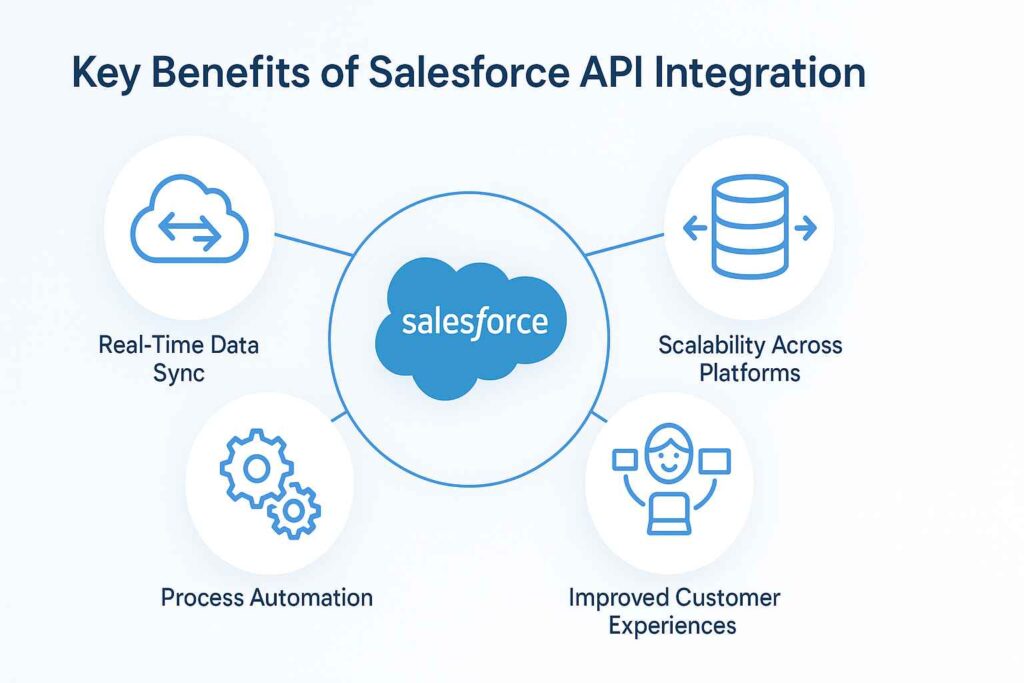
The API system of Salesforce is directly and greatly engineered for addressing the changing combination scenarios and wide transactional data synchronization plus metadata manipulation along with event-driven architectures. At the core, this platform provides:
These APIs can generally and collectively help businesses by moving towards big paradigms & thus enabling fast/seamless data flow and workflow perfection.
Also Read: Salesforce Integration Tools: Quick User Guide
Delay removal through the use of bidirectional synchronization & between systems like external systems and Salesforce. Thus making sure that stakeholders work on the basis of a unified data set.
Centralized integration stages that behave as deep notion layers, thus decoupling Salesforce from the different downstream systems. Some major tools like Dell Boomi provide the governance across multiple API strategies plus reusable connectors.
A majorly centralized instance of Salesforce served as the “single source of truth” that beams with ERP & CRM as well as analysis systems. This type of model prevails in mid-sized operations needed for data consistency.
The methodology of MuleSoft partitions directly combines for system APIs (core data access) and process APIs (front-end abstraction). This sort of modular design accelerates the time-to-market and certifies higher-level scalability.
Utilizing the large capacity of Streaming API, this architecture provides asynchronous and actual updates with publish-subscribe patterns. This is perfect for dynamic or telemetry pricing engines that need deep millisecond level responsiveness.
Also Read: Types of Salesforce Integration Solutions and Their Benefits

Latency suppression with the help of bidirectional synchronization between different external systems and Salesforce, thus certifying the stakeholders can operate upon a consolidated data set.
Automation through the use of repetitive & monotonous undertaking (for instance, case routing plus lead scoring) through the use of Apex REST APIs, reduction in manual intervention as well as minimizing errors in these systems.
Horizontal scaling through the use of bulk API 2.0. It processes millions of records under parallel batches while accommodating for swift data growth.
Merged customer experiences for more than just multi touch points (e.g., Shopify + Service Cloud). These types of experiences allow for hyper-personalized interplay, & nurturing retention through lifespan.
Integration with various platforms, for instance, Marketo and HubSpot, with the advanced use of Tooling API, thus empowering cross-platform analytics plus campaign orientation.
Also Read: Marketing Cloud Next vs. MCE, MCAE, MCG & MCA: The Clear Difference
API | Use Cases |
REST API | Mobile application integration requires JSON-based lightweight endpoints. |
SOAP API | Financial systems that require transactional integrity (for instance – through order fulfillment). |
Bulk API 2.0 | Batch data migration process for massive datasets (e.g., historical level CRM data import). |
Streaming API | Real-time & Actual notifications through the use of field services, dispatch & inventory alerts. |
Metadata API | Automation through Salesforce org configuration (e.g., CI/CD pipelines). |
Tooling API | Programmatic Visualforce page management as well as Apex class Deployment |
APEX rest & SOAP | Customized business logic through the use of secure & authentic touchpoints |
GraphQL API (Pilot) | Federated different queries for Salesforce along with external databases for the hybrid clouds. |
Syncing financial data and inventory levels along with order status in definitive real-time and elimination of any manual reconciliation.
Automation of lead nurturing workflows & progress tracking across different platforms through engagement metrics.
Unification of product catalogs, customer profiles, and their order histories for Salesforce along with storefronts.
Proper centralization of support tickets, knowledge bases & also SLA tracking across different and multiple platforms for unified agent dashboards.
Exposing Salesforce Data through the use of REST API for powering of customer-facing portals or the use of native mobile apps for those in real-time analytics.
Also Read: Top Pitfalls in Salesforce Agentforce Implementation and How to Avoid Them
Monitoring Salesforce API integration as well as daily API requests (vary by license tier), use named credentials for poor connections, and reduce overhead.
Implementation of OAuth 2.0 through the use of JWT bearer flows for and to server-to-server integrations, thus utilizing named credentials for those abstract secrets.
Designing of different APIs with different backoff strategies for mitigation of transient failures for those high-volume transactions.
Adopting semantic versioning for these APIs, thus ensuring backward compatibility through the Metadata API and driving of that schema evolution.
Also Read: Salesforce Retires Marketing Cloud Advertising Studio
In 2025, the power of Salesforce API Integration surpasses outside of technical execution, it’s a perfect blueprint for competitive differentiation and operational resilience. By mastering the core APIs and modern architectures as well as sticking to the best practices, businesses can unlock exceptional agility plus data-driven insights.
However, navigation through this type of complexity demands great expertise. Getting a partnership with Salesforce Consulting partners like CloudMetic provide you with smooth implementation. This gives highly optimized governance and a level of scalability that’s incredibly adaptable for future needs and requirements, thus empowering your organization for thriving in and towards an API-centric world.
A testimonial is a window into the experiences of our clients and partners who've worked with us. Here, we share their feedback on how CloudMetic's solutions, approach, and support have made a real difference.
Locations

No matter your business size, needs, or payments infrastructure, our expert team can help.